
Introduction
Once you have your Framework Laptop 13 set up following the Quick Start Guide, you’re ready to install your preferred OS. Ubuntu 24.04 LTS works fantastically well.
NOTE: This is an Officially Supported Linux Distribution. Learn more here.
Tools
No tools specified.
Parts
-
-
First, download the latest Ubuntu 24.04 LTS Desktop image from Ubuntu's website. We'll go through the steps in this Guide assuming you have a simple installation scenario of a fresh install on a blank drive.
-
Download balenaEtcher as a tool to create the USB installer from the ISO. balenaEtcher is available for MacOS. Install it.
-
Launch balenaEtcher. Insert your USB drive (8GB or larger). Click on "Flash from file" and select the ubuntu-24.04-desktop-amd64.iso that you downloaded. Click on "Select target" and choose your USB drive. Click "Flash" and wait a minute or two for it to complete.
-
Once the USB drive creation is complete, you can close balenaEtcher and eject the USB drive from your OS.
-
-
-
This process will delete all data from the flash drive being used! Ensure any important data that may be kept on those drives is backed up before continuing.
-
First, download the latest Ubuntu 24.04 LTS Desktop image from Ubuntu's website. This guide will follow a basic setup that automatically uses the entire disk.
-
Download Rufus as a tool to create the USB installer from the ISO. The first item in this list will be a link to install installer for the latest version. Install Rufus using this.
-
Open Rufus, from the Device drop-down, select the USB flash drive stick.
-
In order to use devices like external hard drives, external solid state drives, or the Framework Storage Expansion Card to create a live USB, List USB Hard Drives must be enabled under Show advanced drive properties.
-
Use the Select Button next to Boot selection to choose the downloaded Ubuntu ISO.
-
Set Partition scheme to GPT to ensure the live USB is properly recognized at boot.
-
Click Start. A window will pop up to prompt for a choice between dd image mode and ISOHybrid image mode. Select ISOHybrid image mode then OK.
-
-
-
Ubuntu works with Secure Boot out of the box. Ubuntu Live USBs will boot regardless of whether or not it is disabled. Users who intend to dual-boot with Windows should not disable Secure Boot!
-
If a user has a reason to disable Secure Boot, such as specialized third party devices that require unsigned drivers:
-
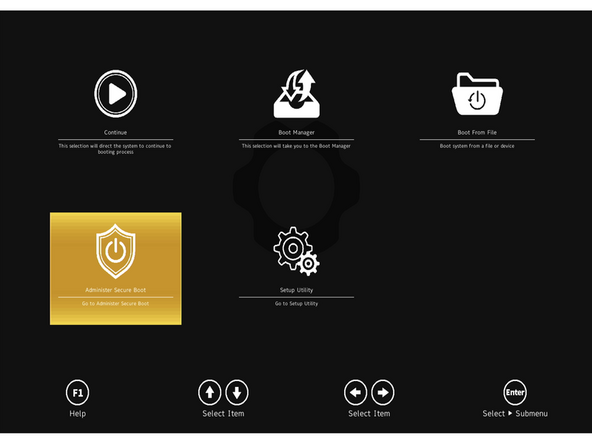
Boot into BIOS by tapping F2 just before the Framework splash screen.
-
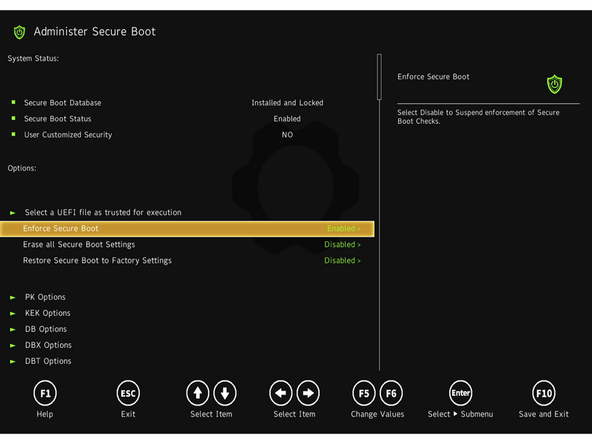
Arrow down to Administer Secure Boot. Press enter.
-
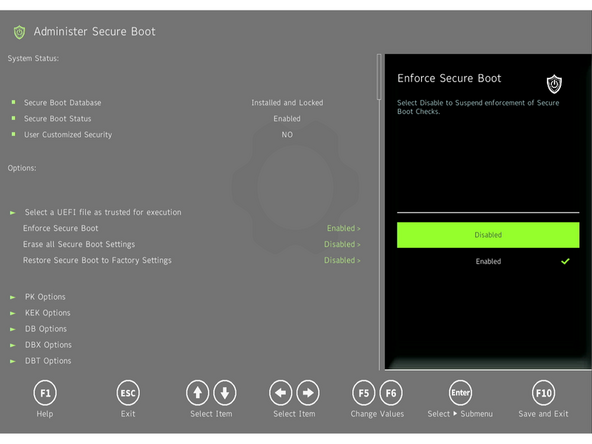
Arrow down to Enforce Secure Boot. Press enter, select Disabled, and press enter.
-
Press F10 to save and reboot. With Yes selected, press Enter.
-
To enable Secure Boot again, repeat the above steps but select Enable this time.
-
-
-
Boot to Live Ubuntu USB: Insert the USB drive into the powered-off machine, then power it on.
-
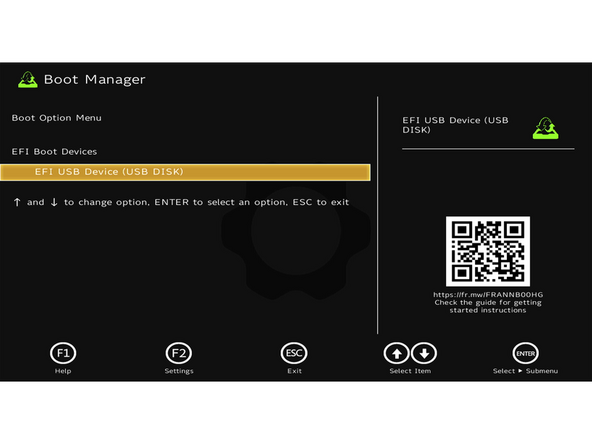
If an OS is already installed, immediately begin tapping F12 as soon as the power light comes on. Start tapping before the Framework logo appears.
-
At the Boot Option Menu, use arrow keys to select your USB drive (shown as "EFI USB Device (USB Disk)" or similar) and press Enter. On the black GRUB menu, confirm "Try or Install Ubuntu" is highlighted and press Enter.
-
If Windows is already installed on the system attempting to boot into a Linux Live USB may result in a "Device is Active" error. This will provide guidance to overcome this error.
-
The Live USB will boot to the Desktop then automatically open the installer. Select a Language as well as any needed accessibility options. Then select a keyboard layout.
-
Important for non-US keyboard users! Please open this link in a new tab and read carefully.
-
Set up an internet connection. There may be a prompt to update the installer. Do so if connected to the internet. Close the installer, then open it again from the desktop on the lower right corner.
-
If the installer has been updated, open the installer again after it closes to complete the update. Repeat the steps on this page from the start. Then select installation type. This guide follows the Interactive option.
-
-
-
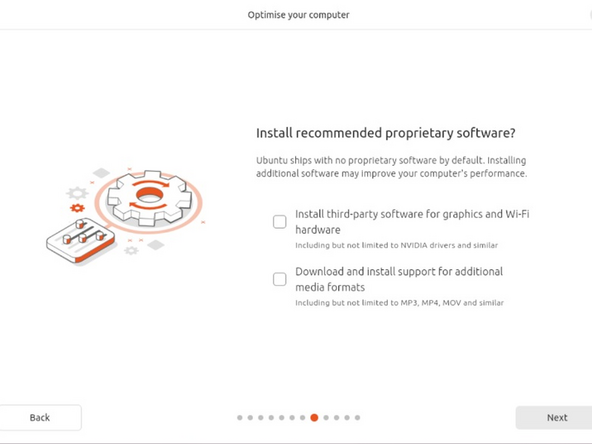
While connected to your network, select Normal installation, Download updates while installing Ubuntu and Install third party software, then press continue. This process may take a few minutes and appear to idle a bit, then the next screen appears - installation type.
-
-
-
Next we’ll choose the installation type. Erase everything is the correct choice for users with a new DIY Framework Laptop 13 looking to use the entire hard drive for Ubuntu.
-
Press Install Now, then when prompted, then click on Continue.
-
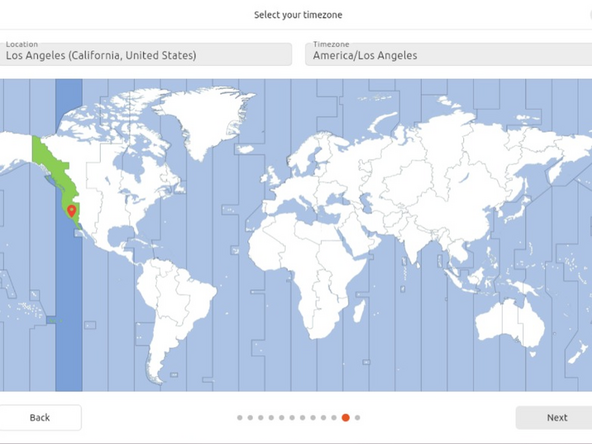
Next you’ll be prompted to choose your location on the world map. Select your time zone location, click Continue.
-
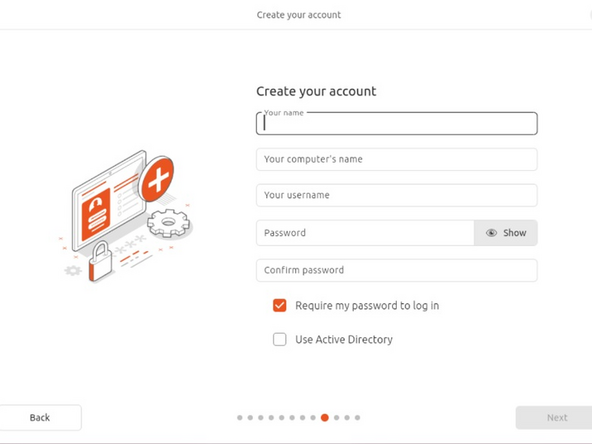
Create a username, a computer name (anything will do), and a password to login with. Also make sure you select Require a password to log in. Then press Continue.
-
-
-
Once the Ubuntu installer is completely done, you will see a box indicating that it's complete and time to reboot. Click Continue testing if you prefer or if you're comfortable and done testing, click the Reboot Now button.
-
After pressing the Restart Now button, it will sit at a black screen for a bit, then you will be prompted to "Remove the installation Medium, then press Enter."
-
-
-
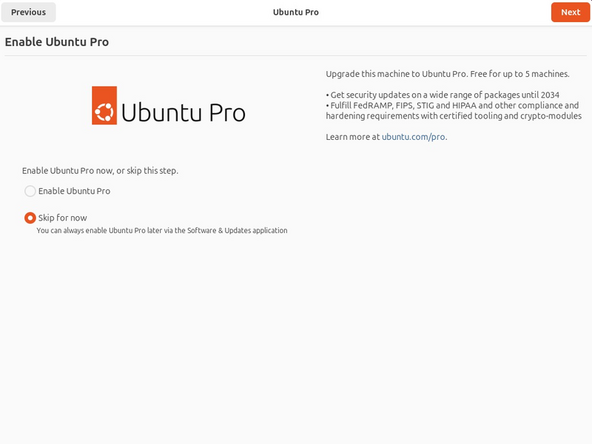
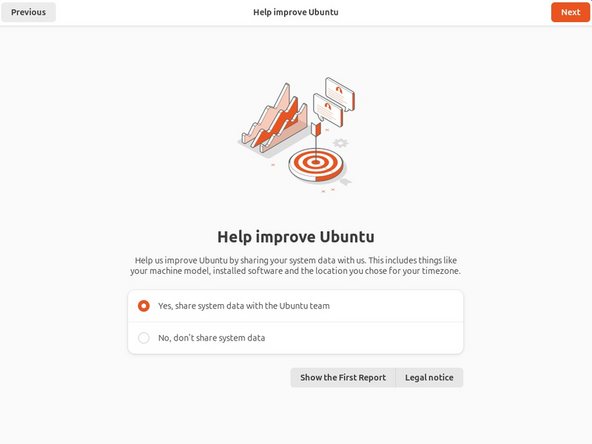
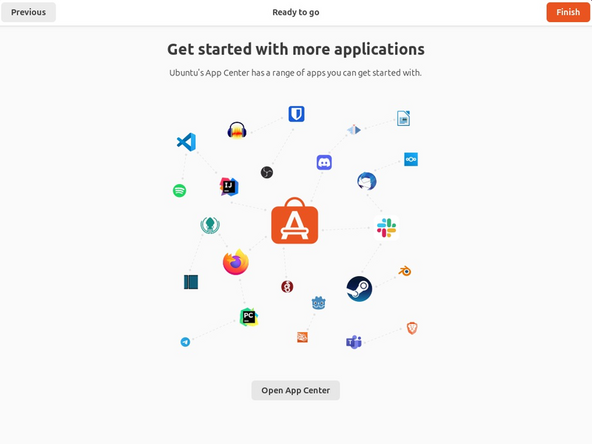
Once rebooted, simply follow the prompts for whether or not you are using Ubuntu Pro and if you wish to send back error reports.
-
Repeat this process with the other screens as seen in the provided images, while making selections and choices that best match your needs.
-
-
-
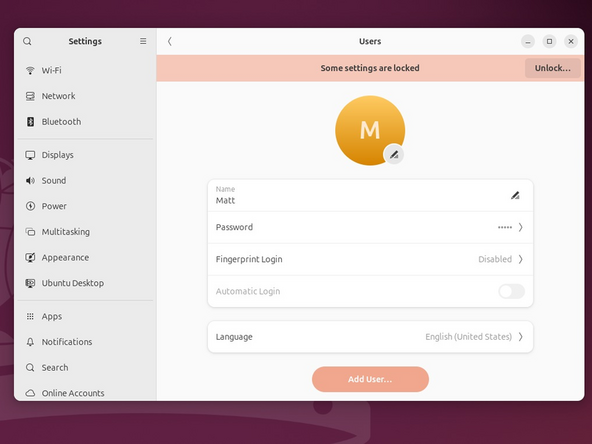
Let's setup fingerprint login. Click on the horizontal bar in the upper left, search for user.
-
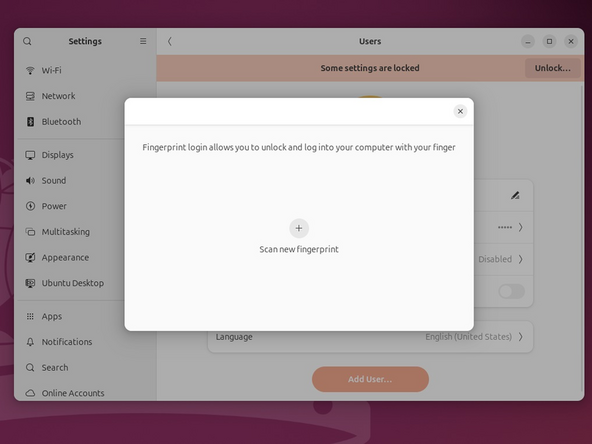
Choose Fingerprint Login. Then select Scan new fingerprint. Select your desired fingerprint. Carefully tap your finger tip on the sensor (power button). You may need to try a few attempts as everyone's prints are different.
-
Once it's successful, you will see the word Complete.
-
If you're experiencing issues getting your fingerprint reader working, please follow our help guide to get your reader working for you on Ubuntu.
-
-
-
We're almost done. Please follow the links to your individual Framework Laptop 13 model (11th, 12th or 13th Gen Intel Core)
-
Click here for the completion guide for 13th Gen Intel Core
-
Click here for the completion guide for 12th Gen Intel Core.
-
Click here for the completion guide for 11th Gen Intel Core.
-
Click here for the completion guide for AMD Ryzen 7040 Series.
-
Click here for the completion guide for Intel Core Ultra Series 1 Must be on kernel 6.8.0-40-generic or later for official support.
-
Our recommendations for Optimizing Ubuntu Battery Life. This includes important expansion card behavior.
-
Need richer sound? We have collected suitable Easy Effects profiles to help.
-
-
-
How to check the BIOS version. Go to and click upper left corner where you see the horizontal line, search terminal and launch it. Please follow this link to copy and paste the code into your terminal, then press enter.
-
The output will tell you which Framework Laptop 13 you have and also which BIOS version you're using.
-
If you have Intel 11th Gen Intel Core, you can check here for the latest firmware.
-
If you have Intel 12th Gen Intel Core, you can check here for the latest firmware.
-
If you have Intel 13th Gen Intel Core, you can check here for the latest firmware.
-
If you have AMD Ryzen 7040 Series, you can check here for the latest firmware.
-
If you have Intel Core Ultra Series 1, you can check here for the latest firmware.
-
IMPORTANT: Per the instructions above, we do NOT recommend updating BIOS and firmware using various GUIs. We recommend using fwupdmgr as provided in the step above. Using GUIs can potentially create issues that would not be present using fwupdmgr directly.
-
-
-
Expecting two-finger right clicking and need help? The touchpad help guide is here.
-
Please visit our troubleshooting guide first.
-
If you need additional help, feel free to visit our active support community.
-





Enjoy using Ubuntu on your Framework Laptop 13! If you have any questions or run into any issues, we recommend bringing them to the Community in the Ubuntu 24.04 topic. Members of the Framework team participate in discussions there.
Enjoy using Ubuntu on your Framework Laptop 13! If you have any questions or run into any issues, we recommend bringing them to the Community in the Ubuntu 24.04 topic. Members of the Framework team participate in discussions there.
Cancel: I did not complete this guide.
7 other people completed this guide.


One Comment
In the case of installing Ubuntu 24.04 in a Windows dual boot scenario, the EFI/boot partition created by Rufus, as per the Framework guide, is too small to perform Ubuntu System Update, at least on the AMD Ryzen 7040 13in Framework. So anyone with a Ryzen 13in Framework who wants to try Ubuntu or use Ubuntu alongside Windows will have a system that can't perform a System Update. There is no guide on how to remedy the issue.