Introduction
Once you have your Framework Desktop set up following the Quick Start Guide, you’re ready to install your preferred OS. The Framework Desktop is running some very recent hardware, and we’ve worked with the team at Bazzite to improve support. Bazzite is one of the Linux distributions we recommend, as it has full hardware support with very little setup required, and it offers a great user experience overall.
This is an Officially Supported Linux Distribution. Learn more here.
Tools
No tools specified.
Parts
-
-
KDE Plasma or GNOME? Unsure which is best for you? Both KDE Plasma or GNOME versions are a solid experience right out of the box.
-
For this guide, we will be using the Bazzite-GNOME installation.
-
Let's continue on to preparing USB Bazzite Installation Media.
-
-
-
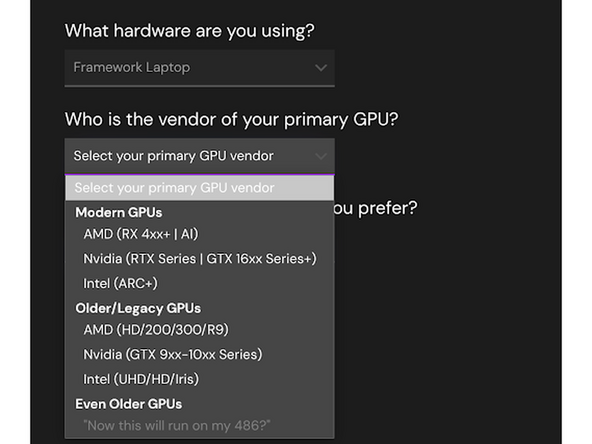
First, download the latest Bazzite release from the Bazzite website. We'll go through the steps in this Guide assuming you have a simple installation scenario of a fresh install on a blank drive.
-
Select: "AMD (RX 4xxx+ | AI)" from Modern GPUs section
-
Download balenaEtcher as a tool to create the USB installer from the ISO. balenaEtcher is available for MacOS. Install it.
-
Launch balenaEtcher. Insert your USB drive (8GB or larger). Click on "Flash from file" and select the Bazzite iso that you downloaded. Click on "Select target" and choose your USB drive. Click "Flash" and wait a minute or two for it to complete.
-
Once the USB drive creation is complete, you can close balenaEtcher and eject the USB drive from your OS.
-
-
-
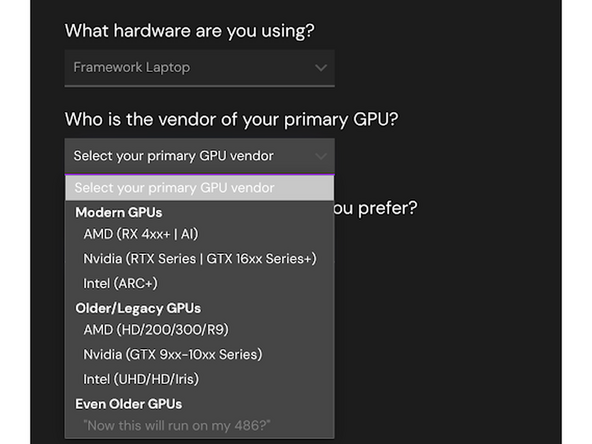
First, download the latest Bazzite release from the Bazzite website. We'll go through the steps in this Guide assuming you have a simple installation scenario of a fresh install on a blank drive.
-
Select: "AMD (RX 4xxx+ | AI)" from Modern GPUs section
-
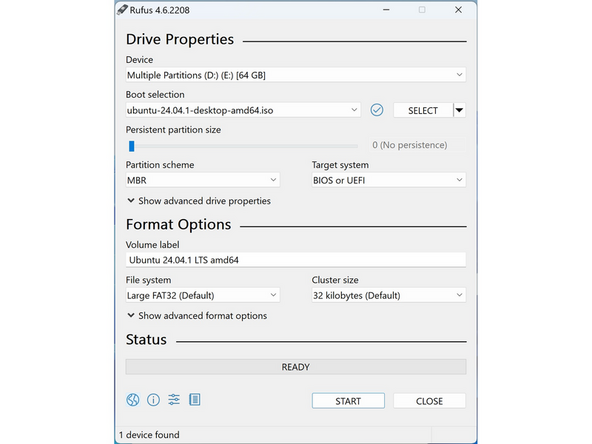
Download Rufus as a tool to create the USB installer from the ISO - select the top download option from the link provided. Rufus is available for Windows. Install it.
-
In order to use devices like external hard drives, external solid state drives, or the Framework Storage Expansion Card to create a live USB, List USB Hard Drives must be enabled under Show advanced drive properties.
-
Use the Select Button next to Boot selection to choose the downloaded Bazzite ISO. Set Partition scheme to GPT to ensure the live USB is properly recognized at boot.
-
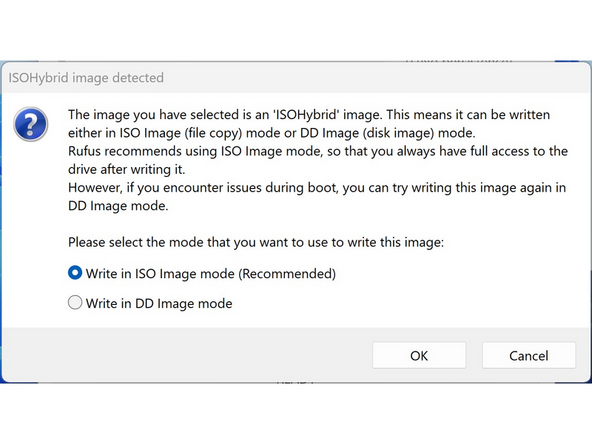
Click Start. A window will pop up to prompt for a choice between dd image mode and ISOHybrid image mode. Select ISOHybrid image mode then OK.
-
-
-
Bazzite works with Secure Boot. Bazzite Live USBs will boot regardless of whether or not it is disabled. Users who intend to dual-boot with Windows should not disable Secure Boot! More about secure boot here. There are Bazzite specific instructions here.
-
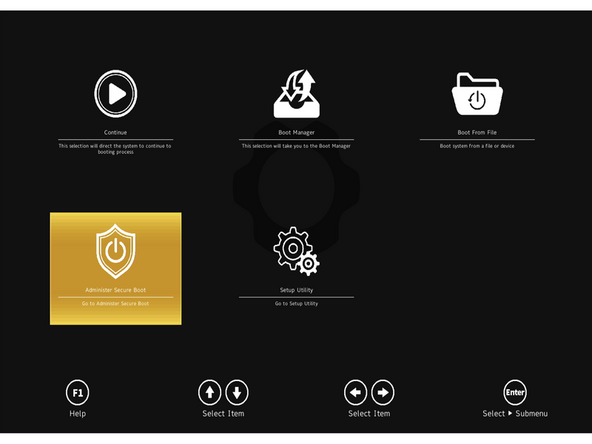
To disable Secure Boot for any reason, boot the system into the BIOS menu:
-
Power on, then tap F2 rapidly at the Framework splash screen
-
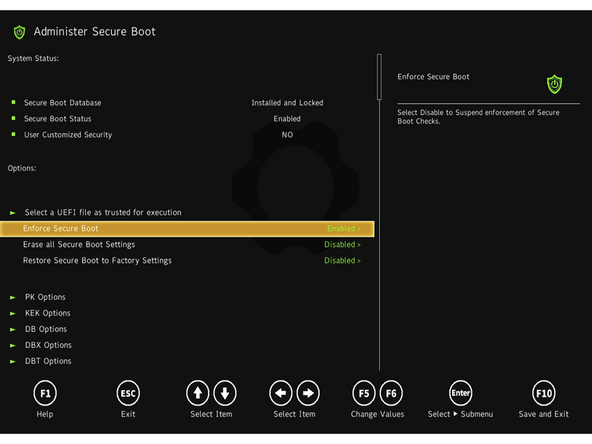
Select Administer Secure Boot tile on the screen. Press enter.
-
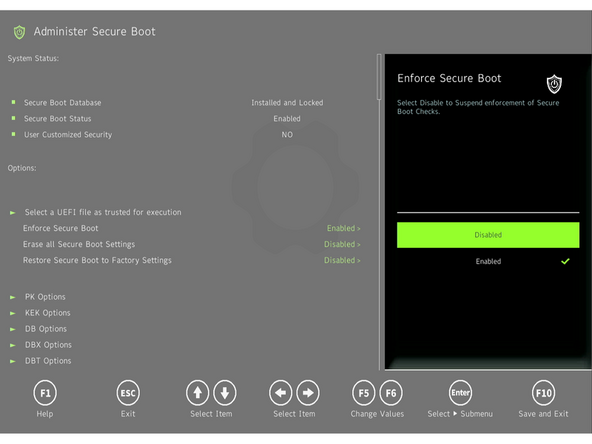
Go to Enforce Secure Boot, it will show as Enabled. Click the enter key, arrow it to Disabled. Press F10 key to save and reboot.
-
IMPORTANT: Do not disable Secure Boot if a drive containing Windows is installed until confirming that Bitlocker is disabled. Disabling Secure Boot while Bitlocker is enabled can lock the user out of their drive and potentially result in data loss.
-
To enable Secure Boot again later in the future, repeat the above steps but select Enable this time.
-
-
-
Insert the USB drive into the powered off Framework Desktop, and then power on.
-
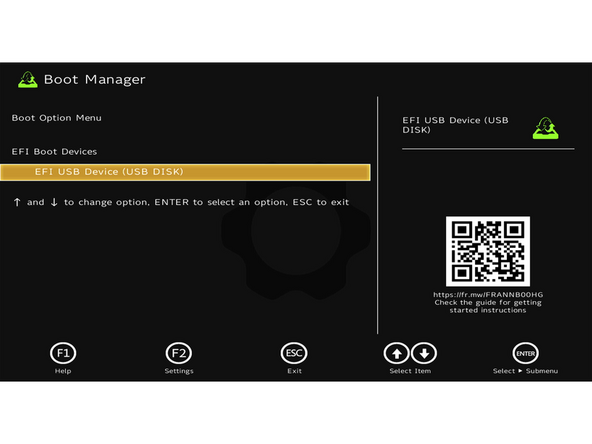
If there is already an OS installed on the internal storage, enter the Boot Manager by tapping F12 after pressing the power button to turn the laptop on. Tap the F12 key until the message "F12 is pressed. Go to Boot Manager." is displayed.
-
Select the USB drive, usually labeled "EFI USB Device (USB Disk)". Press the enter key.
-
If Windows is already installed on the system attempting to boot into a Linux Live USB may result in a "Device is Active" error. This will provide guidance to overcome this error.
-
Next select "Launch Bazzite Installer". Hit the enter key.
-
Important for non-US keyboard users! Please open this link in a new tab and read carefully.
-
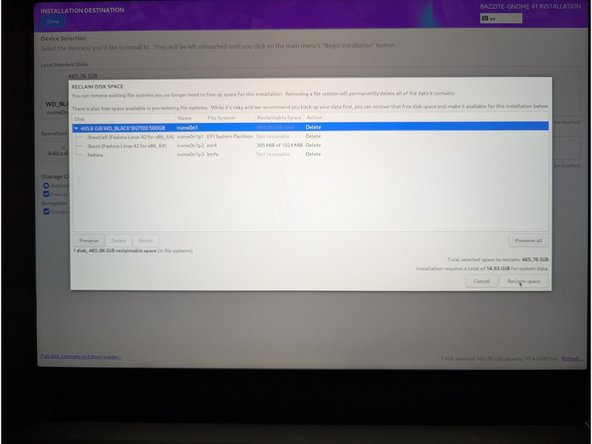
If there is an OS already installed on the target drive, you’ll need to follow the guided steps to delete the existing partitions.
-
-
-
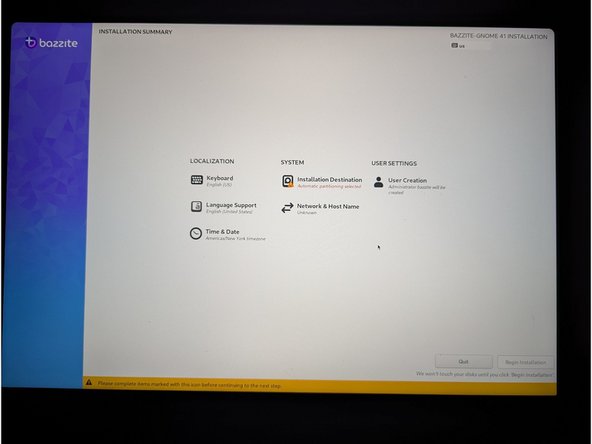
Select the keyboard language you'd like to use. Click Continue.
-
Select Time & Date, select your time zone.
-
Select Installation Destination, check Free up space by removing or shrinking existing partitions. Because we want this to be a dedicated installation on its own, select Delete all, then Reclaim space. Click Done.
-
Encryption. When setting up Installation Destination, you may set up Encrypt My Data by checking the box, creating a passphrase. Then click Done.
-
Select Network & Host Name. Select Network, connect to your wireless network. Once an IP address and DNS entries appear, click Done.
-
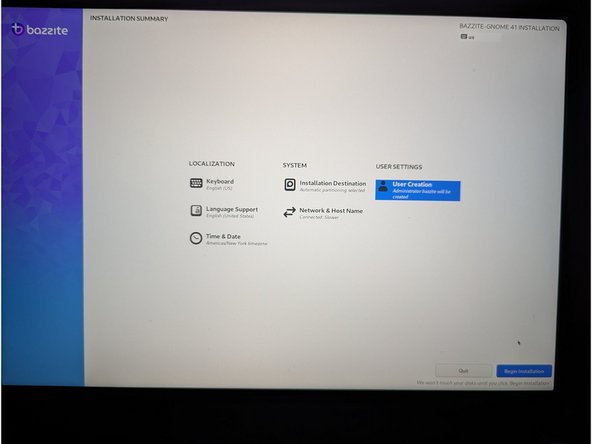
Click user Creation. Provide the full name, leave the boxes checked, create a password. Click Done. (Short passwords will require you to click Done twice)
-
Click the Begin Installation Button.
-
-
-
At the initial start up, two things will appear. The first is the Steam installer. If you do not want to login or setup Steam right now, just close it at the X.
-
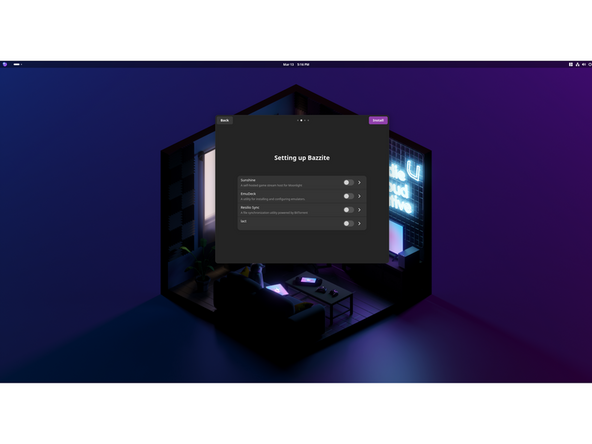
Next we have Welcome to Bazzite! Click Next, make any sections that meet your needs or click Install to skip them altogether with the options unchecked. Ignoring the install throbbing line, click Next once again if no selections were made.
-
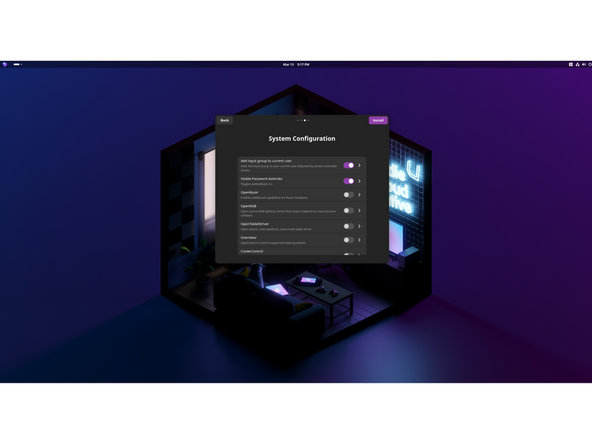
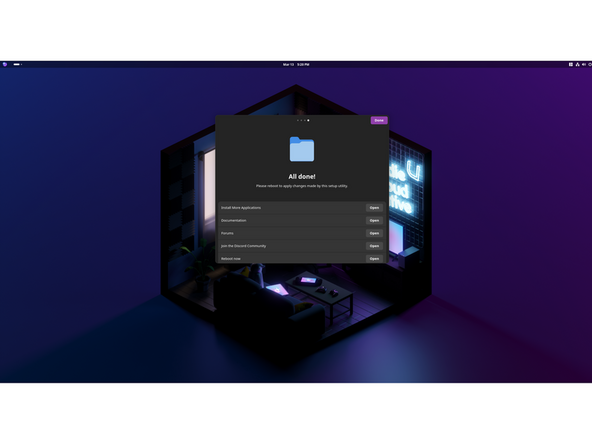
System Configuration. There are options pre-selected for you. Leave them enabled, and also check additional features if you decide you want them. The additional features are optional. Click Install. When presented with Allow Inhibiting Shortcuts box, select allow enter your user password, then OK. When this is complete, click Next.
-
-
-
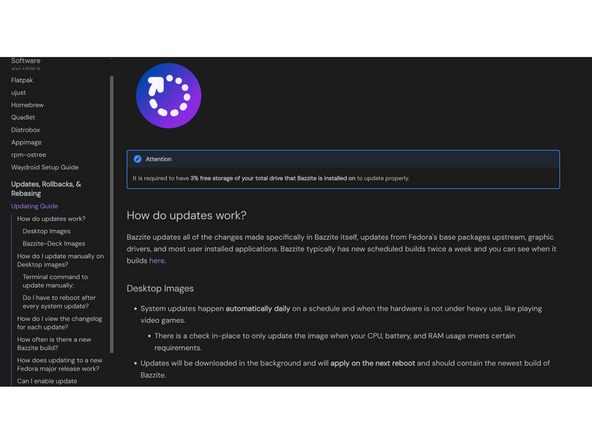
Bazzite handles updates in two very specific ways. Automatically or Manually. If you never bother to manually update, Bazzite will do the work for you.
-
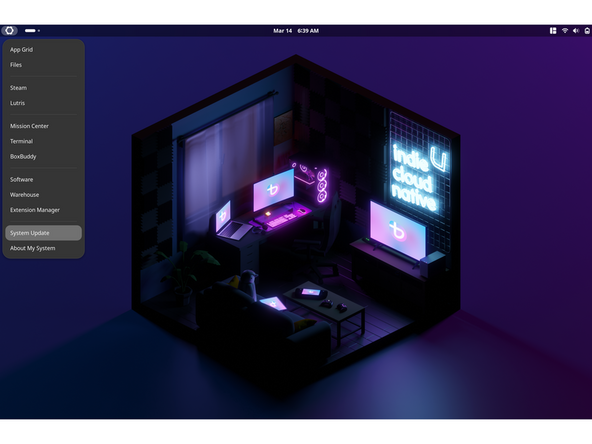
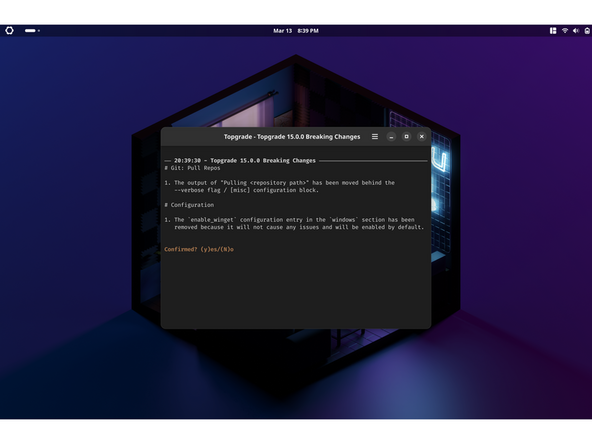
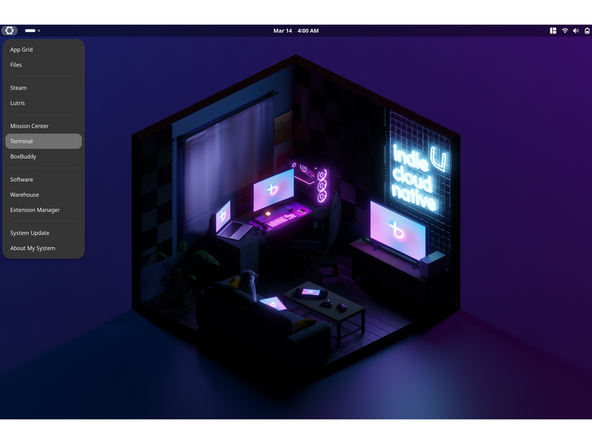
Updates are completely automatic. However, should you wish to run them manually, you can do so from the Framework icon you see in your upper left corner, select System Update.
-
You will be asked to press Y for update. Press Y - no other keys are needed, it's updating. The update process checks for updates for your core system, Distrobox, Flatpacks and firmware.
-
-
-
Bazzite is atomic and by its nature, is resilient. However, should something not work as expected due to a suspected regression - you can roll back your installation to a previous state. This is an automatic feature provided by Bazzite.
-
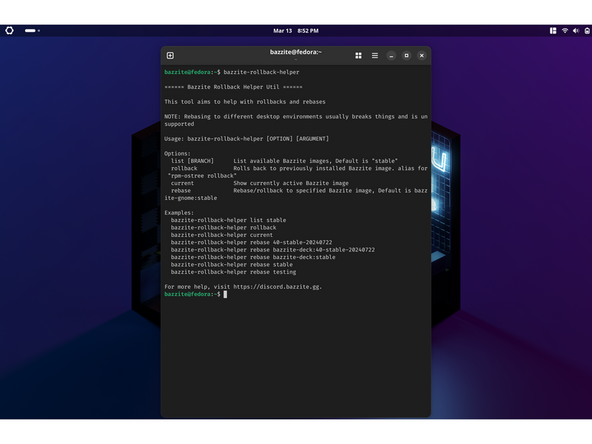
Roll back to the image of your OS before the most recent batch up updates. Just run bazzite-rollback-helper rollback in a terminal. Press enter, reboot when prompted.
-
You should not try pinning releases or moving to rebasing unless it is suggested by support or by someone from the Bazzite team.
-
You can learn more about how the rollback system works here.
-
-
-
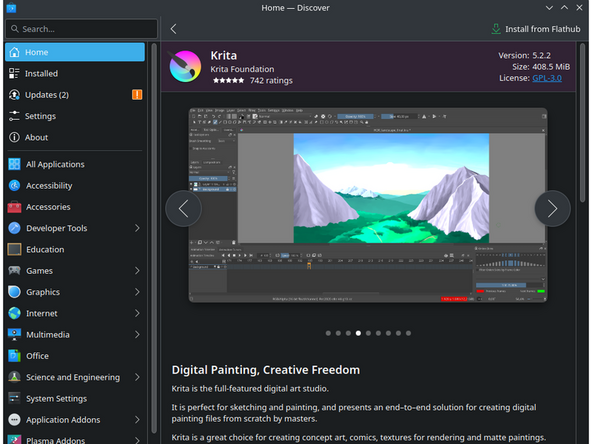
Flatpaks. Installing Flatpaks is the recommended method to installing software. This is the primary method of installing applications on Bazzite and is recommended to use Flatpak over other formats for most software when possible.
-
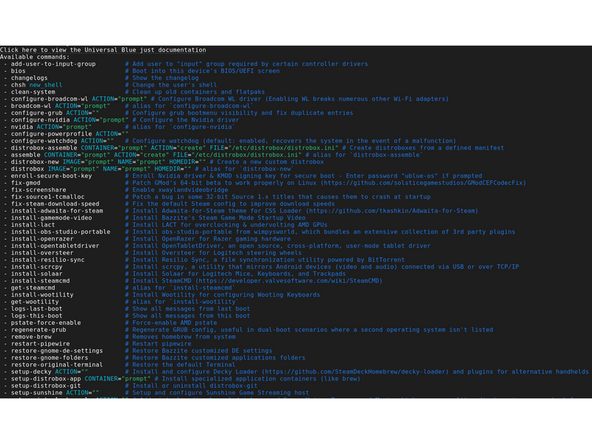
Ujust. Technically ujust is not a package format, but are convenience commands that automate tasks using scripts which can be utilized to install specific software.
-
Homebrew. This is a package manager that installs packages to their own prefix, and is used strictly for command-line interface (CLI) and terminal user interface (TUI) applications. Do not install graphical applications or anything that may override system-level packages with Homebrew.
-
Quadlet. Unlike the above options, this is a features of podman that allows a user to run a container as systemd units. It works by using a declarative syntax like docker compose but integrates to systemd and use podman as a backend.
-
Distrobox. Run other minimal variants of popular Linux distributions in Bazzite inside of a container, and access each distribution's packages without any of their dependencies and libraries affecting the host machine.
-
AppImage. A a universal package format that attempts to bundle every dependency that an application needs into one portable file. Applications installed as an AppImage can integrate with your desktop and be managed with Gear Lever which is pre-installed on Bazzite.
-
Manage OS Rollbacks and Install RPMs. Bazzite uses bootc for core system image management and rpm-ostree for layered package and kernel argument modifications, maintaining a balance between an Atomic base and user customization.
-
-
-
Steam. In Bazzite, Steam is installed and configured out of the box. It can run Windows games on Linux. It utilizes a wide range of projects and patches all packed into a piece of software built-in to Steam called Proton for Windows compatibility.
-
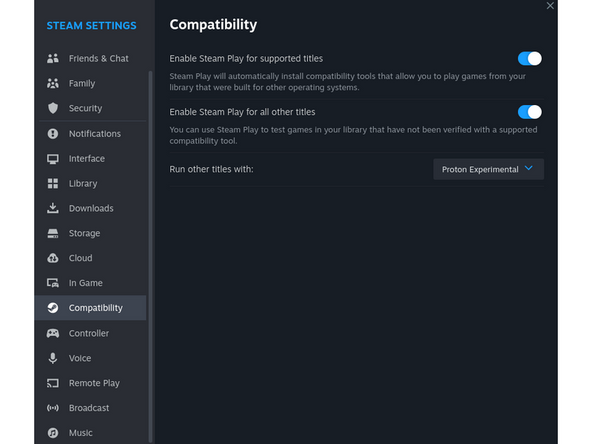
Currently Steam only allows whitelisted games to run by default on the desktop Steam client. You can change this by enabling this in Settings > Compatibility > Enable Steam Play for all other titles.
-
Common Gaming Issues. This provides a guide for some common issues and explains what your options are.
-
Auto-Mounting Game Drives. Read the Auto-Mounting Secondary Drives Guide for more information. It is also recommended to do your own research on drive mounting on Linux.
-
Lutris. A game management software that doubles as a WINE front-end for Windows games. Several games and launchers can be installed by searching for the title and using one of the installer scripts for it.
-
-
-
Making sure you are on the latest firmware. Bazzite automatic updates should handle this for you on Framework Desktop with firmware updates provided by LVFS. As an alternative, you can also check for this manually by attaching to power, then running System Update manually again.
-
So what additional installation tweaking needs to be done? That is it, you're done. Curious what else Bazzite can do? Take a look at their user guide here.
-
-
-
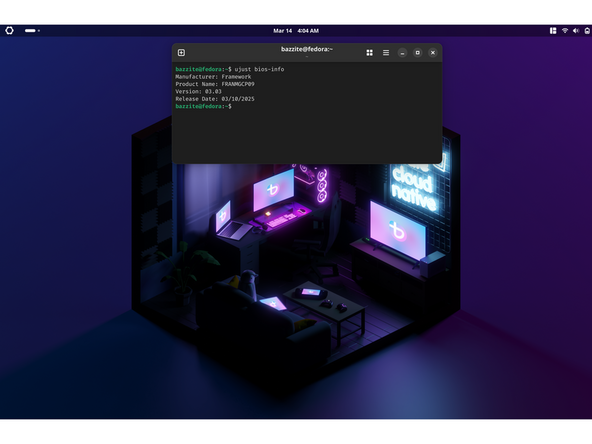
Want to check the BIOS version? Go to and click upper left corner where you see the Framework gear launcher, click Terminal. Type in ujust bios-info, click the enter key.
-
The output will tell you which Framework Desktop you have and also which BIOS version you're using. This section is best suited for both LVFS and EFI options, depending on your hardware. While LVFS is part of the Bazzite update process, you can still do this manually as well.
-
Framework Desktop firmware update link will appear here when it's ready.
-
-
-
As a general rule, your Bazzite installation experience should be nearly flawless. That said, there are exceptions.
-
-
-
-
When reaching out to Support, indicate you are running Bazzite and then create the following text files below, include them in your reply to support's first email to you:
-
ujust logs-last-boot > last-boot.txt
-
ujust logs-this-boot > this-boot.txt
-
sudo bootc status > bootc.txt
-




Enjoy using Bazzite on your Framework Desktop!
Enjoy using Bazzite on your Framework Desktop!
Cancel: I did not complete this guide.
One other person completed this guide.